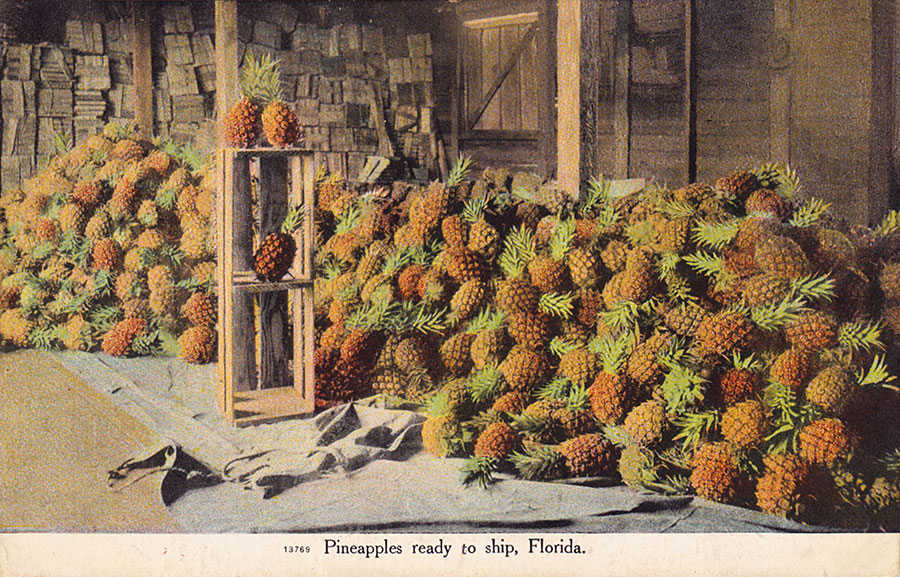
Tiny Pineapple Gallery

A plethora of pineapple pictures...


Spongebob’s House

November 14, 2001

The Dunmore Pineapple

November 14, 2001

Pineapple Princess, 1939

March 19, 2003

Dole Guides

March 23, 2005

Dole Water Tower

April 24, 2005


One of Hawaii’s Big Crops

November 28, 2006

The Pineapple Girl, Honolulu

December 15, 2006

Pineapples in Savannah

December 28, 2006


Hawaiian Harvest

May 27, 2007


Sun-Ripened and Sweet

June 5, 2007


62 — MARTINIQUE

June 8, 2007


Farmers Market

June 14, 2007


Libby’s Surfer Girl

June 16, 2007

Pineapple Growing

June 18, 2007

Pineapple Head, 1982

June 21, 2007


Pineapple Harvesting

June 29, 2007


Stunned

July 15, 2007

C162 — Planting Pineapple

"Smile..."

"After the pineapple slip has been planted through holes made in the mulch paper, it grows to maturity in about a year and a half. Then, it bears, at intervals of six months, a total of about a dozen pines, by which time its life cycle is finished."

I have to wonder how many copies of this postcard they sold back in the 1940s. It seems to me that the market for such a thing would be...not large.

"Honey, the luau starts at 6 o'clock, so I'm going to find a beach chair by the pool and read until then. If you're going out, could you see if they have anything in the gift shop that we can add to our collection of Hawaiian souvenirs featuring agricultural workers' butts?"


Plantation Paradise

"Where Pineapples Grow"

GIFT SHOP and FRUIT STAND
Our Specialties: Frosty Pineapple Juice
Homemade Preserves and Candies

U.S. Hwy. 27, 4 miles South of Lake Placid, Florida

Open Daily 8:00 A.M. to 5:00 P.M.
Bring Your Camera and Stroll Through Our Tropical Garden


Plantation Paradise

Pineapple Pickin' Beauties

A few of the pineapple pickin' beauties in Plantation Paradise only 4 miles south of Placid Tower, The Tower of Peace, Lake Placid, Florida, on toll free U.S. 27 South.


Pining For You

But I'm No Indian...

pine

verb [intrans.]
  1. suffer a mental and physical decline, esp. because of a broken heart. She thinks I am pining away from love.
  2. (pine for) miss and long for the return of. I was pining for my boyfriend.

Origin: Old English pinian [(cause to) suffer,] of Germanic origin; related to Dutch pijnen, German peinen 'experience pain,' also to obsolete pine [punishment]; ultimately based on Latin poena 'punishment.'

Here are two examples of turn-of-the-century postcard humor. Both feature a gentleman pining for a loved one and in both cases he's got a pineapple for a head. Get it? Pining? Pineapple? The wordplay is genius. And what's funnier than a guy with a pineapple for a head?

"I'm Crazy Pineapple-Head! And I want some candy! I don't have a normal head, I got a pineapple growing out of it! Now, give me some crazy candy! Ow-ooo, this pineapple makes me crazy!"

But would someone...anyone...care to explain that second example to me? "I'm no Indian but I do pine for you?"

Sure, the pineapple originated in the New World, but by the turn of the century the pineapple was most often associated with the South Pacific and the Far East, so surely it can't be referring to Native Americans. Yet the Republic of India has never been a major producer of pineapples, so what other explanation is there?

It makes about as much sense as...

I'm no Lithuanian but I've bean missing you.

...or...

I'm no British North Bornean but I'm plum out of patience with your absence.


An Ample Harvest

Celebrating nature's bounty...

"The oval to cylindrical-shaped, compound fruit develops from many small fruits fused together. It is both juicy and fleshy with the stem serving as the fibrous core. The tough, waxy rind may be dark green, yellow, orange-yellow or reddish when the fruit is ripe. The flesh ranges from nearly white to yellow. In size the fruits are up to 12 in. long and weigh 1 to 10 pounds or more."

- California Rare Fruit Growers' Pineapple Fruit Facts


Luscious Golden Hawaiian Pineapple

With Juan Valdez Kaiulani...

"Luscious golden Hawaiian pineapple. One of Hawaii's most famous products."


Field Ripe Pineapples

Hey! You kids!

"Field ripe pineapples ready for canning by Del Monte. Pineapple is a major crop in Hawaii, word's largest producer."


Pineappalope Postcards

Large fruit never fails to fascinate...

Turn-of-the-century bromeliadian variations on the giant jackalope theme.


Vendedora de Piñas

by Diego Rivera

Jodi's Pineapple Pictures

ananas comosus (L.) jodiverse

A few years ago, my muse, my goddess, my all...Jodi...who I shall henceforth refer to as "She Who Will Some Day Be Mine," was kind enough to create an original pineapple picture for me which I posted in the Tiny Pineapple Gallery under the title "L'ananas de Jodi."

Since then, "L'ananas de Jodi"...or "Jodi's Pineapple"...or "The Pineapple of She Who Will Some Day Be Mine" (although that last one sounds like a Renaissance-era anatomical euphemism)...has become one of the most popular exhibits in the Tiny Pineapple Gallery. So popular, in fact, that I once received a serious inquiry from someone who actually wanted to buy the "original."

Well, what many people don't know is that She Who Will Some Day Be Mine...or "Jodi," as she is sometimes referred to by They For Whom She Will Not Some Day Be...occasionally takes a respite from chronicling her encounters with couscous, canines, and chronometers to snap pictures of pineapples she chances upon during her madcap, gadabout, bohemian, big city jaunts.

I present them here now, not only to showcase the work of a goddess artist, but also in hopes of eliciting a monetary offer for the "originals" sufficient for me to purchase a plane ticket to New York where I will camp on her doorstep and recite breathtakingly overripe love poems night and day until she promises to marry me...or has me committed, whichever comes first.


The First Pineapple Illustration

by Gonzalo Fernández de Oviedo y Valdés

The first illustration of a pineapple in the New World appeared in 1535 in the 19-volume La Historia general de las Indias by Gonzalo Fernández de Oviedo y Valdés.

"Gonzalo Oviedo sailed in 1514 on the first of his many journeys to America, where he compiled detailed descriptions and woodcut illustrations of products and goods found in the New World. The Spaniard introduced Europe to an enormous variety of previously unheard of 'exotica,' including the pineapple, the canoe, smoking tobacco, the manatee, and the hammock. Along with Pedro Mértir de Anglería and Bartolomé de Las Casas, Oviedo was one of the first European 'chroniclers of the Indies' having written two comprehensive works on America, including the rare Historia."

- American Treasures of the Library of Congress


17th-Century Pineapple Engraving

Stapleton Collection

I'm a bit baffled by the perspective in this 17-century engraving. Either the pineapples in the foreground are quite close and the people in the background are quite far away, or those are two very non-tiny pineapples.


Continuation der Nürnbergischen Hesperidum

by Johann Christoph Volkamer

"...Astonishingly beautiful illustrations of citrus fruits, flowers, exotic plants, landscapes, cities, villages, palaces, gardens and garden art (including sundials and an obelisk with Egyptian heiroglyphs), as well as garden, building and city plans, labyrinths, etc. Most of the plates show a large illustration of a fruit (or less often a flower) above a small view of the garden, village, city or region where it is found, resulting in frequently surreal effects reminiscent of Roald Dahl's James and the Giant Peach. Many include people engaged in various activities, and some of the botanical illustrations also include insects, spiders, birds, etc., including pests that damage the fruits: 'delightful views of the gardens and palaces of Germany, Austria and Italy' (Blunt); 'engraving as fine as this is not really improved by colour' (Raphael); 'the vignettes and tailpieces...are so attractive that they have often been borrowed to decorate later books' (Raphael)."

- Asher Rare Books

Additional Reading:


Ananas aculeatus

by Georg Dionysius Ehret

The pineapple on the left is from Christopher Jacob Trew's Plantae Selectae (Nuremberg, 1750-73), which was illustrated by Georg Dionysius Ehret.

"Georg Ehret was one of the finest flower painters in 18th century Europe, and his work still stands as a preeminent accomplishment of European botanical art. Born in Heidelburg to a market gardener, Ehret began his working life as a gardener's apprentice, eventually becoming a chief gardener for the Elector of Heidelburg and the Margrave of Baden, whose prize tulips and hyacinths he painted.

"Ehret soon moved on to a number of cities across Europe, collecting eminent friends and important patrons as he traveled. Ehret's list of benefactors includes the most brilliant and generous amateurs of his day, among whom was Dr. Christoph Trew, a wealthy Nuremburg physician who became his lifelong patron, friend and collaborator. Ehret also gained the admiration of Bernard de Jussieu in Paris, and the great Swedish naturalist Linnaeus. In England, where he eventually settled, Ehret became the only foreigner to be elected a Fellow of the Royal Society.

"The Plantae Selectae was the culmination of many years' collaboration between Ehret and Trew. The 100 illustrations were selected for their exotic appeal and botanical interest. Many tropical subjects had only recently been introduced to Europe and were still unknown to the general public. Jacob and Haig translated Ehret's beautiful, accurate and remarkably sensuous watercolor studies into remarkably faithful hand-colored engravings. Plantae Selectae is certainly one of the most exquisite and dramatic of the great botanical works."

- Ursus Books

Additional Reading:


The Pineapple Series

by Sir William Jackson Hooker

Sir William Jackson Hooker (1785-1865) was a renowned 19th-century botanist who served as the first "official" Director of the Royal Botanic Gardens, Kew from 1841 to 1865.

"William Hooker's illustrations of plants combine meticulous accuracy and attention to the smallest detail with enormous graphic technique and graceful presentation, and are acknowledged masterpieces of botanical art. Hooker's illustrations of fruits are perhaps without equal. Both an artist and a gardener, Hooker had a remarkable knowledge of fruits. As a result, the Horticultural Society of London commissioned him to paint and describe about 150 of the most attractive and interesting varieties then being cultivated. The Pineapple series demonstrates his meticulous attention to detail and artistic skill, coupled with his extensive botanical knowledge of the subject."

- Original Source Unknown

Additional Reading:


Maui Pineapple Co. Decal

What all the cool cars were wearing in 1967...

These decals were placed on Maui Pineapple Co. vehicles in the 1960s to identify them for entry into the pineapple cannery complex. The decal color was changed to orange in 1970.


The Big Pineapple

The Anti-Tiny Pineapple

"A spectacular 50ft. high replica. Contains an observation deck and 2 floors of audio-visual displays of Queensland's tropical production. Overlooking the POLYNESIAN ROOM (tropical restaurant and gift shop) and a tour by SUGAR CANE TRAIN through scenic SUNSHINE PLANTATION."

Additional Reading:


Doubletree Club Hotel

Orlando, Florida

"This Official Walt Disney World Good Neighbor hotel provides the best value in the Downtown Disney Resort Area. Located at the entrance to the Downtown Disney Resort Area and central to all of Orlando's great attractions. This first-class hotel features a colorful tropical-magic theme and is ideal for the vacationing family or the business traveler."

- Doubletree Club Hotel Web Site

My brother's in-laws had the opportunity to stay at this hotel when they were visiting Florida a while back. This large pineapple sits atop the entrance of the hotel, contributing, I suppose, to both the "colorful" and "tropical-magic" aspects of the "colorful tropical-magic theme."


Pineapple Head

by Crowded House

Listen To A Clip: Pineapple Head (MP3 format, 32 seconds, 540k)

"Pineapple Head," written by Neil Finn, was included on Crowded House's 1993 album Together Alone. The image on the left is from the cover of the CD single of "Pineapple Head" that was available in the U.K. and Australia.

Neil Finn talked about the origins of the song in an interview with David Hepworth in the June 1994 issue of Mojo Magazine.

DH: "How do you start a song?"

NF: "I basically rely on getting my first few lines by just singing something and writing it down and not thinking about it at all. So initially I get just a natural image like sky, sea, sun, earth and then something very domestic like washing. The juxtaposition of those things is endlessly interesting."

DH: "Can you remember the process afterwards?"

NF: "'Pineapple Head' is an obvious example. It started with my son Liam who had a fever. He was delirious and I was standing by with a cloth to cool him down and he just started talking about all these things. 'Pineapple Head! Pineapple Head!' Then he said 'detective is flat' and 'getaway car'. So instead of staying there and doing what a father should do I ran downstairs and committed it to a song. Until my wife Sharon came in and looked at me in horror and said, 'What are you doing here?' At the time you've got to go. There's enough times when the idea pops into your head and you're not on the ball enough to write it down. Liam's 11 and I've exploited him mercilessly over the years. He wrote the line 'here comes Mrs. Hairy Legs' in 'Chocolate Cake.'"

DH: "So does 'Pineapple Head' mean anything?"

NF: "'Pineapple Head' has the least meaning in the literal sense of any of the songs on the record, but in a strange way for me it all makes perfect sense. Line by line anyway. And the chorus is put over from the point of view of a fever, a virus, inhabiting somebody. 'I'll play you like a shark and I'll clutch at your heart and come flying like a spark to inflame you.' The rest of it's just a stream of consciousness delirium put down on paper."

Here are the complete lyrics:

Pineapple Head

Detective is flat
No longer is always flat out
Got the number of the getaway car
Didn't get very far
As lucid as hell
These images moving so fast
Like a fever
So close to the bone
I don't feel too well

And if you choose
To take that path

I will play you like a shark
And I'll clutch at your heart
I'll come flying like a spark
To enflame you

Sleeping alone
For pleasure, the pineapple head
It spins and it spins
Like a number I hold
Don't remember if she was my friend
It was a long time ago

And if you choose
To take that path

I will play you like a shark
And I'll clutch at your heart
I'll come flying like a spark
To enflame you

Sleeping alone
For pleasure, the pineapple head
It spins and it spins
Like a number I hold
Don't remember if she was my friend
It was a long time ago

And if you choose
To take that path
Would you come to make me pay?


Pineapple Princess

by Annette and The Afterbeats

Listen To A Clip: Pineapple Princess (MP3 format, 27 seconds, 465k)

It could be argued that without "Pineapple Princess," from Annette Funicello's 1960 album Hawaiiannette, there would never have been "A Spoonful of Sugar," a "Supercalifragilisticexpialidocious," or a "Jolly Holiday" with or without Mary.

The Sherman brothers, Richard and Robert, were relatively unknown songwriters when they teamed up with Annette Funicello in 1958. While their first hit with Annette was "Tall Paul," co-written with Bob Roberts (no, not that Bob Roberts), it was their 1960 hit "Pineapple Princess," recorded by Annette and The Afterbeats, that reached #11 on the pop charts and established them solidly in the wonderful world of Disney.

After writing songs for both The Parent Trap (1961) and Summer Magic (1963) they were approached by Walt Disney to write the songs and the score for Mary Poppins (1964) and the rest is history.

They won Oscars for both "Best Musical Score" and "Best Song" (for "Chim Chim Cher-ee"), won the grammy for "Best Original Score Written for a Motion Picture or Television Show," and helped make Julie Andrews a movie star.

I hope that, at the very least, Ms. Andrews sent The Afterbeats a fruit basket as a token of her apprecation.

Here are the complete lyrics:

Pineapple Princess

"Pineapple Princess," he calls me, "Pineapple Princess," all day
As he plays his ukulele on the hill above the bay.
"Pineapple Princess, I love you, you're the sweetest girl I've seen.
Some day we're gonna marry and you'll be my Pineapple Queen."

I saw a boy on Oahu isle
Floatin' down the bay on a crocodile.
He waved at me and he swam ashore
And I knew he'd be mine forevermore.

"Pineapple Princess," he calls me, "Pineapple Princess," all day
As he plays his ukulele on the hill above the bay.
"Pineapple Princess, I love you, you're the sweetest girl I've seen.
Some day we're gonna marry and you'll be my Pineapple Queen."

He sings his song from banana trees
He even sings to me on his water skis.
We went skin-divin' and beneath the blue
He sang and played his ukulele, too.

"Pineapple Princess, I love you, you're the sweetest girl I've seen.
Some day we're gonna marry and you'll be my Pineapple Queen."

We'll settle down in a bamboo hut
And he will be my own little coconut.
Then we'll be beachcombin' royalty
On wicky-wicky wacky Waikiki.

"Pineapple Princess," he calls me, "Pineapple Princess," all day
As he plays his ukulele on the hill above the bay.
"Pineapple Princess, I love you, you're the sweetest girl I've seen.
Some day we're gonna marry and you'll be my Pineapple Queen."


Pineapple Rag

by Scott Joplin

Listen To A Clip: Pineapple Rag (MP3 format, 26 seconds, 420k)

"Pine-apple Rag (1908): The third theme of this rag has the vocal quality that probably suggested its future use as a song; otherwise a strange choice. It is not particularly distinctive except for a joyful and very ragged second theme but is well enough constructed and substantial."

- Scott Joplin and the Ragtime Era

"Not particularly distinctive," my eye! The mere mention of that most noble of bromeliads in the title elevates the song above all of Mr. Joplin's other botanical rags: "Maple Leaf Rag," "Sugar Cane Rag," "Sunflower Slow Rag," "Palm Leaf Rag," "Gladiolus Rag," "Rose Leaf Rag," and "Fig Leaf Rag."